abstract
The topic of environmental justice is a widely debated topic when it comes to policymaking. Oftentimes, political figures or judges may assume that environmental racism simply doesn’t exist because it can be scientifically proven, but not proven to be a violation of civil rights laws. However, environmental racism can fall under the UN Sustainability Goal 11, which aims to “make cities and human settlements inclusive, safe, resilient and sustainable,” and Goal 16, which aims to “promote peaceful and inclusive societies for sustainable development, provide access to justice for all and build effective, accountable and inclusive institutions at all levels.” Combining both of these goals, the issue of environmental justice aims to advocate for communities of color, as those who have been historically redlined, no matter their socioeconomic status, tend to have a history of constructing highways and factories surrounding the neighborhoods, and ensure that they are free of NO2 and fine particulate matter pollution.
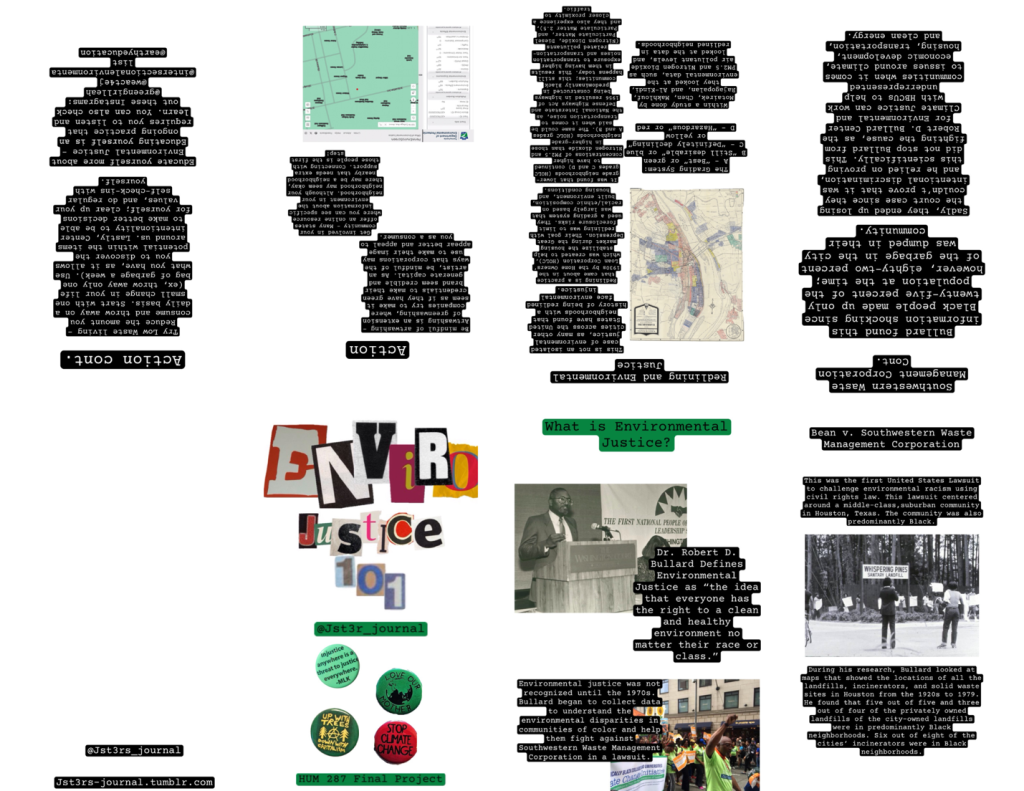
The issue of environmental justice can be attributed to the work of Robert D. Bullard during the civil rights case, Bean v. Southwestern Waste Management Corp., which centered on a middle-class, suburban community in Houston, Texas, that was predominantly Black. Within my project, I have compiled a short history of environmental justice by sharing a brief history of the civil rights case Bean v. Southwestern Waste Management and Robert D. Bullard’s commitment to the environmental justice cause. I then go to discuss how the history of redlining is ingrained in environmental racism and has even ensured that this system is set in place, because neighborhoods that were viewed as more desirable (HOLC A and B graded neighborhoods) had historically less pollution, noise exposure, and more green space compared to those that are considered less desirable (HOLC C and D graded neighborhoods). I then finish off my zine by providing readers with organizations in the area they can get into contact with, potential social media accounts to follow, or simple changes one can make in their life to impact the environment positively. Environmental racism is a real issue that is present within our daily lives, whether we are directly impacted by it or not. The issue of environmental justice is an issue that can potentially affect us all if we do not take the appropriate steps of action to prevent further devastation of our environment. To make my work accessible to all and pleasing to the eye, I decided to go the route of creating a zine. Words that can be easily distributed can spark change.
zine forthcoming! check out Tavi’s blog here !